I draw on my multidisciplinary background to look at the challenges people and organisations face in our increasingly globalised world. I am particularly interested in topics linked to multicultural leadership and team collaboration, cultural differences in the workplace, diversity and inclusion, using English as a corporate Ianguage and its effect on employees, leadership discourses and global leadership skills.
I adopt an empirical approach in my research: I look at what is going on in the real world, in its complexity and fuzziness and try to explain it with relevant theories from management, leadership, intercultural communication and applied linguistics.
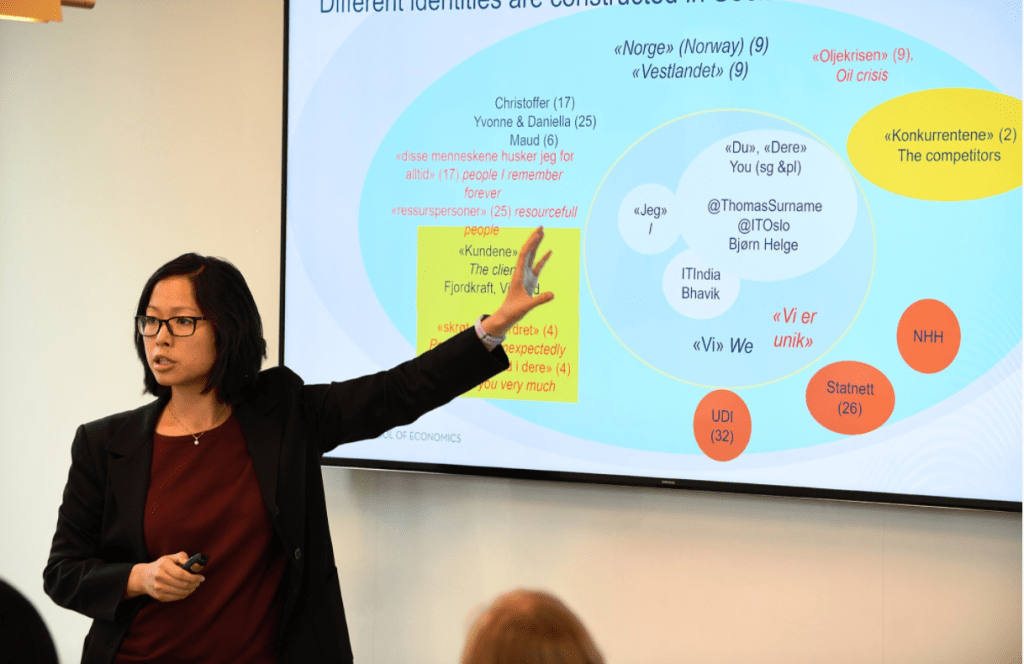
I have worked on several projects, briefly explained below. The list of my publications can be found under.
- Cultural differences in the workplace: The globalisation of business has created new corporate structures where employees from different national backgrounds may become colleagues and collaborate effectively. What are the key challenges facing employees working internationally? How do employees perceive and make sense of cultural differences in the workplace, and how do their perceptions affect collaboration?
- Communication in English as a corporate language and email communication: Successful communication among colleagues is essential but challenging. It can be even more challenging when employees need to communicate in English. What are the consequences of implementing English as a corporate language when it is not employees’ mother tongues? In my research, I have found that while face-to-face communication may work well, email communication is particularly challenging, as the sender and receiver do not see cues to interpret the message. Thus, I have further looked at how people write emails, and how these emails can be perceived by people from other cultures. In one of my projects, I examine how Northern European write emails in English, expressing requests, criticisms and disagreements, and how these emails are perceived by Asian employees.
- Diversity and workplace integration: Research shows that a diverse workforce increases creativity, productivity and profitability. Yet, this is only true if the diverse competencies and experiences are used to their fullest potential. How can leaders develop their diversity management skills to maintain their international staff? Today in Norway, almost 17% of the Norwegian population is of foreign origin (first and second generation). How can organisations include foreign talents to their fullest? What are current challenges and best practices? In my current project, I examine how highly skilled migrants in Norway perceive language requirements in the workplace, and the strategies they adopt to integrate in the Norwegian society.
- Leadership communication: Communication is essential for leaders to motivate and inspire employees. How do leaders effectively craft their messages and communicate? How do they engage their audiences? In this project, I look at how well-known leaders (such as Emmanuel Faber and Steve Jobs) successfully construct their leader identity in their speeches to inspire and convince their audiences. In another project, I also look at crisis communication and how, when not well managed- as in the case of United Airlines in 2017- it can impact the brand and the leader’s reputation.
- Internationalisation of corporate values abroad: Corporate values are essential in creating a shared vision, and a direction to motivate employees. The role of management then is not only to define and communicate these values, but also to translate them into day-to-day practice so that employees believe and internalize these corporate values. When the organisation goes international, corporate values need to be carefully communicated to the subsidiaries. This can be challenging, particularly when there are significant linguistic and cultural differences between the HQ and the subsidiary, leading to a misalignment of values. How can leaders successfully translate corporate values to their subsidiaries abroad and implement the company culture abroad?
- Teaching in an innovative way: Research shows that students learn better when they are actively engaged in the classroom. In my research, I detail what teaching methods I use to develop intercultural skills and leadership skills in the classroom, also when I teach digitally. I regularly receive top evaluations from my students, and have been awarded the status of Excellent Teacher practitioner. More on my teaching in the Teaching section and in the Media section.
List of publications:
- 2022 The role of recontextualization and socialization practices in transferring corporate values from a small Norwegian IT company to an Indian subsidiary, The International Journal of Human Resource Management, (with T.Sverdrup)
- 2022 Developing future global leaders’ competencies in a business school course: A case study of a course design inspired by Team-based learning, Advances in Global Leadership, Vol.14
- 2021 Fostering student engagement and oral practise in an online French course during COVID-19: Implementation, Reflection and Strategies, Handbook of Research on Effective Online Language Teaching in a Disruptive Environment, edited by LeLoup, J & Swanson, P. IGI Global
- 2021 Redéfinir le dirigeant d’entreprise: le retravail de l’ethos collectif dans le discours de remise de diplômes de Faber (Redefining the business leader: the reworking of the collective ethos in Faber’s commencement speech), Argumentation et Analyse du Discours [En ligne], 26 | URL: http://journals.openedition.org/aad/5204
- 2021 Strategies to Survive on Foreign Turf: Experience Sharing and Reflections from Two Apparent Aliens in the Field. In Field Guide to Intercultural Research, edited by D. Guttormsen, J.Lauring & M.Chapman, Edward Elgar (with I. Spjeldnæs)
- 2019 Réflexions pour repenser le management interculturel (Reflections to rethink intercultural management), in Les Nouvelles voix/voies de l’interculturel, edited by F.Dervin & N. Augier, Le Langage et l’Homme, L’Harmattan, 23- 34
- 2017 Making sense of Communication and Cultural Differences in the Workplace: The Case of Sino-Scandinavian Collaborations, in Intercultural Communication with China Beyond (Reverse) Essentialism and Culturalism?, edited by F. Dervin and R. Machart, Springer Publishing, 111-131
- 2016 International internal communication: a transdisciplinary approach, Ph.D. Thesis, NHH
- 2016 Challenges of teaching intercultural business communication in times of turbulence, in Intercultural Competence: Alternative Approaches for Today´s Education, Edited by F. Dervin and Z. Gross, Palgrave McMillan, 215-236 (with K. Rygg)
- 2016 Internal email communication in the workplace: is there an “East-West divide”? Intercultural Pragmatics, Vol 13, 1, 37-70
- 2015 Getting Access to Language Data in the Workplace: Role Enactment as a Data-generation Method, in The Ins and Outs of Business and Professional Discourse Research, Reflections on interacting with the Workplace, Edited by G. Alessi, G. Jacobs, Palgrave McMillan
- 2014 Le sommet sur le changement climatique de Copenhague en 2009 et les espérances brisées au Parlement européen (The United Nations Climate Change Conference in Copenhagen in 2009 and European Parliament shattered hopes) In Interpréter l’événement. Aspects linguistiques, discursifs et sociétaux. Lambert-Lucas, 155-163 (with K.Fløttum)
- 2013 Images and roles of the European Union in the climate change debate: A cognitive approach to metaphors in the European Parliament, in Speaking of Europe: Approaches to complexity in European political discourse, Edited by K.Fløttum, John Benjamins. 151-170
- 2013 A critical discussion of Hofstede’s concept of Power Distance. In SYNAPS 28 51-66
- 2011 Combattre le changement climatique: réflexions sur les métaphores du climat au Parlement européen. Signes, Discours et Sociétés [en ligne], SDS_7 Représentations métaphoriques de l’univers environnant, juillet 2011






 Annelise Ly